




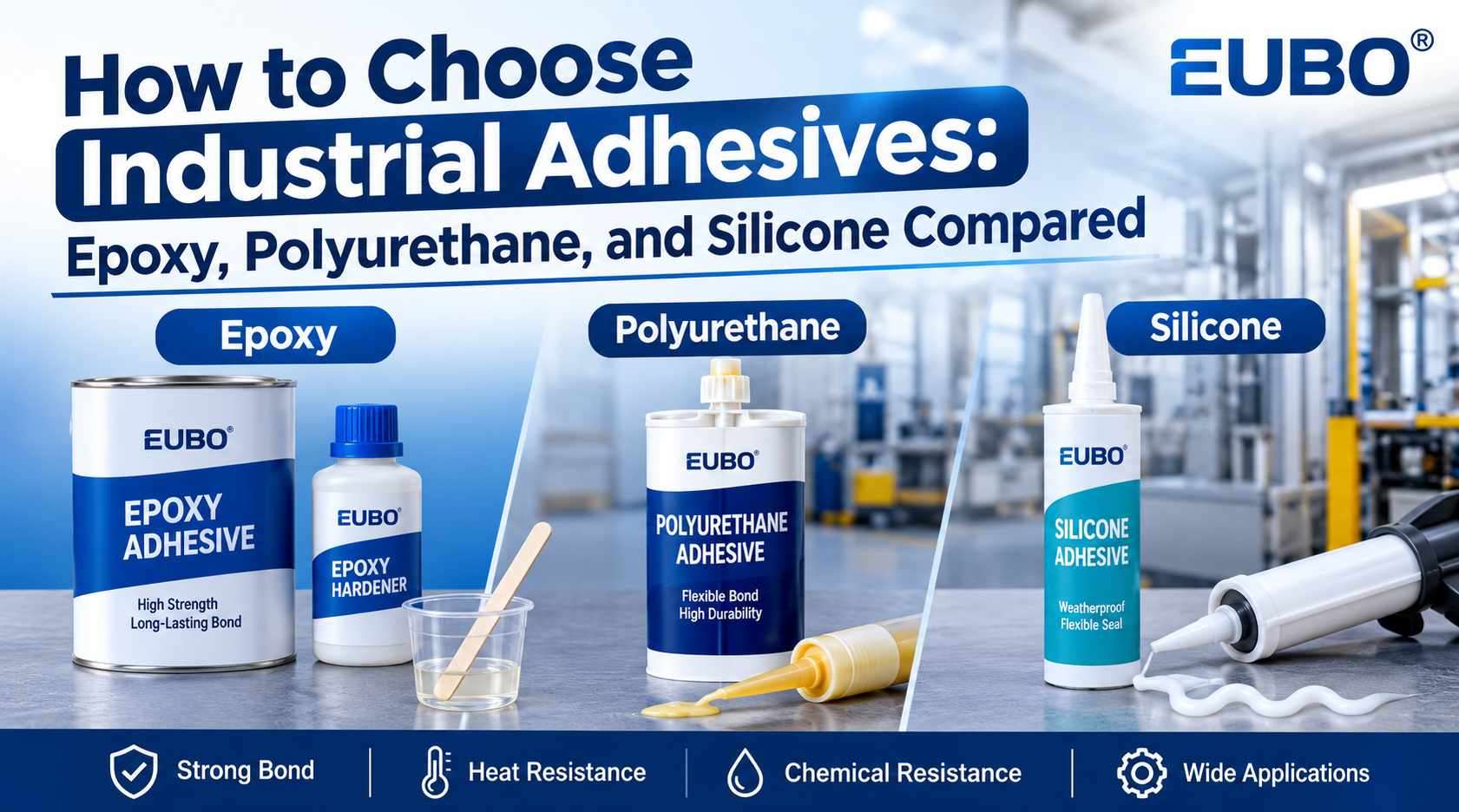
Choosing the wrong industrial adhesive can lead to bond failure, costly rework, and delayed shipments that damage customer trust. For manufacturers and wholesale buyers, the decision usually comes down to three main chemistries: epoxy, polyurethane, and silicone. Each performs differently under load, heat, moisture, and movement, so no single option suits every application. This EUBO guide compares all three side by side, explains the selection factors that matter most, and shows how to source industrial adhesives in bulk with confidence, backed by the technical documents and sample testing that protect your production quality.
Industrial adhesives are engineered bonding materials used to join metals, plastics, glass, rubber, and composites in manufacturing and assembly. Unlike general-purpose glues, they are formulated to handle specific stresses such as vibration, thermal cycling, chemical contact, and outdoor exposure. Choosing the correct type matters because a poor match can cause bond failure, warranty claims, and production downtime, which often cost far more than the adhesive itself.
No single adhesive performs best in every situation, so selection should start with the application rather than the product. Reviewing six practical factors before requesting quotes helps narrow the options quickly and prevents expensive trial and error. Buyers who document these requirements upfront also communicate more clearly with suppliers, which shortens sampling time and improves the accuracy of technical recommendations.
Start by identifying every surface being bonded. Metals, engineered plastics, glass, rubber, and composites all have different surface energies, which affects how well an adhesive wets and grips. Low-energy plastics such as polypropylene often need primers or surface treatment, while metals usually require cleaning and light abrasion for a reliable bond.
Consider how the joint will be stressed in service. Shear and tensile loads favor rigid adhesives, while peel, impact, and vibration call for tougher or more flexible chemistries. Matching the adhesive to the dominant stress prevents cracking, debonding, and fatigue failure over the product's expected lifespan.
Check both the minimum and maximum temperatures the joint will see, including short spikes during processing. Standard epoxies and polyurethanes suit moderate ranges, while silicones handle far wider extremes. Always confirm limits on the technical data sheet, since rated values vary widely between formulations from different manufacturers.
Moisture, chemicals, salt spray, and UV light can weaken a bond over time. Outdoor and marine equipment needs adhesives with proven weathering resistance, while factory equipment may face oils and solvents instead. Defining the exposure conditions early helps suppliers recommend a formulation that stays reliable throughout the product's service life.
Cure behavior directly affects throughput. Fast-curing systems keep assembly lines moving, while slower cures allow repositioning and deeper penetration on large parts. Consider whether the process uses room temperature, heat, or moisture curing, and make sure fixture time, handling strength, and full cure time fit your production schedule.
Export buyers must also check regulatory requirements in the destination market. Depending on the product, this may include RoHS, REACH, food contact approvals, or flame retardancy ratings. Requesting compliance documents before ordering avoids customs delays and protects your brand when selling to regulated industries such as electronics or food equipment.
Epoxy adhesives are the go-to choice when a bond must be strong, rigid, and chemically stable. They are typically supplied as one-part heat-cure or two-part systems that harden into a tough thermoset. Because they resist solvents, fuels, and many chemicals, epoxies are widely used in structural assemblies, electronics, and metal fabrication, where dimensional stability and long-term load bearing matter most.
Epoxies deliver high shear and tensile strength, strong adhesion to metals and many plastics, low shrinkage during cure, and good electrical insulation. Many grades remain stable at elevated temperatures, with specialty formulations rated well above 150°C, making them dependable for load-bearing joints.
Epoxy works well for metal-to-metal structural bonding, potting and encapsulating electronic components, composite repair, and tooling. It is also common in machinery assembly where joints must stay rigid and resist chemicals. Buyers often choose it when mechanical fasteners would add weight or create stress points.
Cured epoxy can be brittle, so it performs poorly under heavy impact or peel loads. Two-part systems require accurate mixing ratios, and some grades need heat to cure fully. Flexibility is limited, which can be a problem when bonded materials expand at different rates.
Polyurethane adhesives sit between rigid epoxies and soft elastomers, offering a useful balance of strength and flexibility. They cure by reacting with moisture or a second component and form tough, elastic bonds that absorb shock and vibration. This makes them popular in transportation, construction, furniture, and packaging, where bonded parts must move slightly without cracking or separating under daily use.
Polyurethanes offer high elongation, strong impact and fatigue resistance, and good adhesion to a wide range of substrates including wood, metal, plastics, and composites. They bond dissimilar materials well because they flex with differing expansion rates, and many grades remain tough at low temperatures.
Common uses include automotive and truck body panels, trailer flooring, wood and panel lamination, insulation boards, and footwear assembly. Polyurethane suits joints exposed to vibration or repeated movement. It is often selected when manufacturers need to bond mixed materials without sacrificing durability under dynamic loads.
Moisture-curing types can foam if the substrate or air is too humid, and uncured material has limited shelf life once opened. Standard polyurethanes may degrade under prolonged UV exposure unless protected or painted, and their heat resistance is generally lower than epoxy or silicone.
Silicone adhesives are built for extreme temperatures, outdoor exposure, and joints that must stay flexible for years. Their inorganic backbone resists heat, cold, ozone, UV light, and moisture far better than most organic adhesives. As a result, silicones are widely used in electronics, lighting, appliances, solar equipment, and sealing applications where long-term weather resistance is more important than maximum bond strength.
Silicones typically perform from about -50°C to 200°C, with specialty grades going higher. They stay elastic, resist water and weathering, and provide good electrical insulation. Their softness allows them to absorb thermal expansion and vibration, protecting sensitive parts from stress.
Typical uses include bonding and sealing electronic housings, LED fixtures, gaskets, appliance components, and outdoor enclosures. Silicone is ideal where a joint faces heat cycling, humidity, or UV exposure. It is also valued for protecting circuit boards and connectors against moisture and vibration.
Silicone offers lower structural strength than epoxy or polyurethane, so it is rarely used for heavy load-bearing joints. Surface preparation or primers are often needed, and cured silicone is difficult to paint. Silicone contamination can also interfere with nearby coating processes.
A side-by-side view makes the trade-offs easier to see. The table below summarizes how each adhesive type performs on the factors buyers ask about most often. Values are typical ranges and vary by formulation, so always confirm specifications with the supplier's technical data sheet. Use it as a quick screening tool, then validate your shortlist with samples and application testing.
|
Factor |
Epoxy |
Polyurethane |
Silicone |
|
Bond strength |
Very high |
High |
Low to moderate |
|
Flexibility |
Low (rigid) |
High |
Very high |
|
Typical temperature range |
Up to about 150°C, specialty higher |
About -40°C to 100°C |
About -50°C to 200°C or more |
|
Chemical resistance |
Excellent |
Good |
Moderate |
|
UV and weather resistance |
Moderate |
Moderate |
Excellent |
|
Relative cost |
Medium to high |
Medium |
Medium to high |
|
Best for |
Structural metal bonding |
Mixed materials and impact |
Heat, outdoor use, electronics |
Verdict: choose epoxy for strength, polyurethane for toughness and flexibility, and silicone for heat and weather resistance.
The right choice becomes clearer when you match the adhesive to the real-world scenario. Instead of asking which product is best, ask which failure risk matters most for your application and production conditions. Use the scenarios below as a starting point, then confirm with samples, since surface preparation, joint design, and cure conditions also influence the final result in actual use.
Many adhesive failures trace back to avoidable selection errors rather than defective products. Buyers working under cost pressure or tight deadlines often skip steps that would have exposed problems early. Recognizing these common mistakes helps procurement and engineering teams avoid rework, returns, and supplier disputes, especially when the same adhesive will be used across multiple production batches and shipments.
Sourcing industrial adhesives in bulk requires more than comparing price per kilogram. Reliable suppliers provide consistent batch quality, clear documentation, and responsive technical support. Before placing a large order, request samples, run a pilot test on your actual substrates, and confirm that the supplier can maintain the same formulation across repeat shipments. Asking the right questions early protects both quality and delivery schedules.
If you are comparing suppliers, explore our industrial adhesive range or contact our team to request samples and technical documents.
More blogs like this:
Choosing Between Silicone Grease and Structural Adhesives
How Electronic Adhesive Improves Durability in Electronic Devices
Grease and Adhesive Buying Guide
What Should Industrial Buyers Check Before Purchasing Silicone Grease in Bulk?
Epoxy is generally stronger in shear and tensile strength, making it better for rigid structural joints. Polyurethane has lower ultimate strength but greater flexibility and impact resistance. The better choice depends on whether your joint faces static loads or movement, shock, and vibration.
Silicone is rarely used for heavy structural bonding because its strength is lower than epoxy or polyurethane. However, it works well for light-duty bonding, sealing, and joints that need flexibility and weather resistance. Some specialty structural silicones exist, so check the data sheet.
It depends on the plastic type and the load. Epoxy and polyurethane are common choices for metal-to-plastic bonds, while silicone suits flexible or heat-exposed joints. Low-energy plastics may need primers or surface treatment, so test samples on your actual materials first.
Shelf life typically ranges from six months to two years, depending on the chemistry and packaging. Store adhesives in sealed containers at the temperature stated on the data sheet, away from moisture and direct sunlight. Always check the manufacturing date and expiry before use.
Outdoor joints face UV light, rain, and temperature swings that can degrade some adhesives. Silicone and weather-resistant polyurethane or epoxy grades are common outdoor choices. For indoor applications, mechanical and chemical demands usually drive the decision more than weather resistance.
Request the technical data sheet, safety data sheet, and relevant compliance certificates such as RoHS or REACH. For bulk orders, also ask for batch test reports, shelf life information, and packaging details. These documents confirm performance, support customs clearance, and help you compare suppliers fairly.
Epoxy, polyurethane, and silicone each solve different bonding problems. Epoxy delivers rigid strength, polyurethane provides toughness and flexibility, and silicone offers heat and weather durability. The safest way to choose is to define your substrates, stresses, temperatures, and exposure conditions first, then validate with samples. Ready to source with confidence? Contact us for samples, and a wholesale quote!!
Choosing the w
READ FULLChoosing the
READ FULLIndustrial buy
READ FULL