




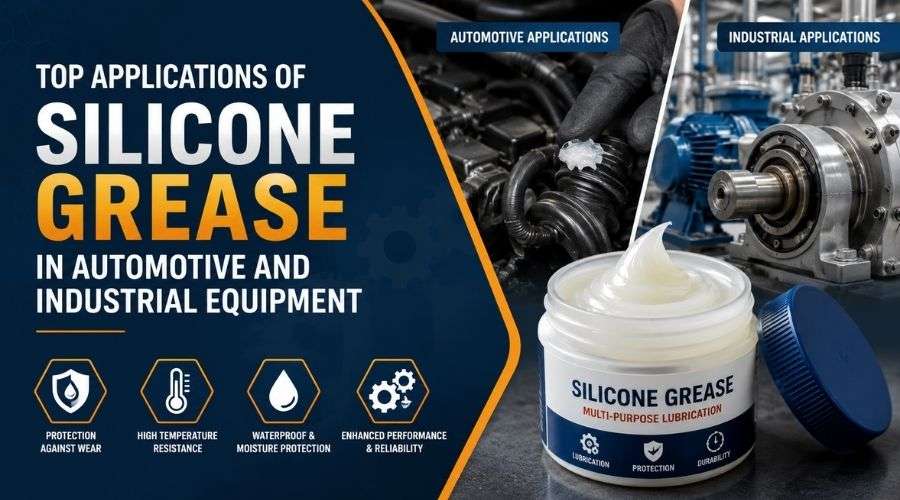
It is easier to find silicone grease on the shelf in almost any well-equipped garage or maintenance shop. It is one product that has been available for decades and continues to be worth its weight in numerous applications. Silicone grease is not a simple grease. It's a high-performance, temperature and moisture-resistant compound suitable for use where other greases can't be used. This blog will explain where silicone grease is used in autos and other industries, and why it is so effective for those applications.
Silicone grease is silicone oil mixed with a thickener and other fillers. The outcome is an even, white, or translucent paste that does not dry and is not easily rinsed off, and it has a very broad temperature range. Most silicone grease will hold up well to approximately -40°C to 200°C or higher, depending on the temperature. Silicone grease will not damage rubber or plastic parts as petroleum grease would. This allows for use with a much wider range of materials. It also features excellent electrical insulation qualities, making it useful not just for mechanical but also electrical and electronic applications.
Need bulk silicone grease for your business? Get competitive wholesale pricing today.
Silicone grease is applied in more places than most drivers would think in the automotive industry. It works quietly yet effectively in maintaining the proper operation of vehicles, from the brake system to the door seals.
Individuals use silicone grease on the brake caliper slide pins. The pins enable the caliper to slide down as the brake pads wear. This causes uneven pad wear or loss of braking function. The pins are coated with silicone grease to ensure smooth operation without harming the rubber boots that prevent dirt and moisture from getting at the pins.
It's used on the backs of brake pads to reduce vibration and squeal. A thin layer between the pad and caliper piston absorbs high-frequency vibrations without impacting braking. There's one little thing to consider here. Never use silicone grease on brake friction surfaces, brake rotors, or brake drums. Use only on the non-friction metal parts of the brake assembly.
Rubber seals are found in cars. Silicone grease can be used on any area with a seal, for example: Door, Boot, sunroof, and Window. It helps to maintain the rubber elasticity and plasticity, and prevents it from getting dry and cracked later on. A good rubber seal provides a better seal against water, wind noise, and dust.
In addition, silicone grease is used in the engine and cooling system to apply to O-rings. A thin layer of silicone grease under an O-ring during a service or repair operation will help assure a seat without damage or twist.
Water is among the leading causes of car electrical issues. Water entering the connectors causes corrosion and intermittent faults that can be hard to track. Silicone grease can be applied to electrical connections, even in small amounts, to create a moisture barrier around these connections. It also simplifies connector removal for servicing. This application is particularly beneficial in exposed vehicle areas like terminal blocks, wheel side lighting connectors, and battery connectors.
Silicone grease will be used for installing rubber coolant hoses and thermostat housings. It lubricates the hose during fitting without degrading the rubber. It can also help develop a better initial seal between the hose and the metal fitting. The silicone grease will keep the rubber consistent in expansion when the engine is hot or cold.
In addition to the automotive industry, silicone grease is applied in various industrial applications. It is stable and resistant to oil and chemicals, and is suitable for use in harsh environments where other lubricants last only a short time.
Silicone grease, which can be used in food processing systems, is available in food-grade. It is used in machinery that comes into contact with food as a lubricant for mechanical parts, valves, and seals. When silicone grease comes into contact with food by mistake, it does not contaminate the food as it is chemically stable and non-toxic.
Lubrication is needed for moving parts and seals for pumps, mixers, conveyors, filling machines, and other machinery in a food factory. Silicone greases handle the daily clean-up process, water, and cleaning chemicals much better than petroleum-based greases do.
In pharmaceutical equipment manufacturing, hygiene is crucial. Silicone grease is used for pump seals, fittings, valves, and other components on all pharmaceutical production lines. It is suitable for cleanroom applications and complies with sterilization norms in pharmaceutical facilities. Pneumatic and Hydraulic Systems
O-rings and seals are used in pneumatic cylinders and hydraulic components to hold pressure. Grease is added to seals during assembly and maintained with silicone grease. Ensures that the seals remain pliable and will not stick or rip during pressure cycling. The grease will also act as a sealant, giving the seal more uniformity in sealing ability.
Silicone grease has a low viscosity, resulting in minimal changes to airflow or pressure in seal areas, especially in pneumatic systems. This makes it the choice for many pneumatics applications, rather than thicker petroleum greases.
Silicone grease has high dielectric properties. This means that it is not an electrical conductor. This also contributes to its utility in electrical use in conjunction with its lubricating properties.
Silicone grease is used on contact surfaces, bushings, and insulator surfaces in medium- and high-voltage switchgear. It is used to prevent tracking caused by moisture and contamination on insulator surfaces. With proper maintenance cycles, silicone grease can extend the service life of switchgear.
Large quantities of connectors are employed in control and power circuits in industrial machinery. Silicone grease prevents corrosion and provides good contact when it's installed.
The marine environment is one of the harshest for any material. Corrosion and rapid lubricant degradation occur when operating in salt water, in wet conditions, or when exposed to extreme temperatures. Silicone grease is considered to be suitable for these conditions.
It is used on rubber seals, seacock valves, and through-hull fittings throughout marine vehicles. It is also used to provide moisture protection for electrical connectors and navigation equipment. Silicone grease is applied on valve stems, flange gaskets, and instrumentation fittings on offshore platforms and marine rigs, where salt air and spray are always a concern.
The work performed by tractors, bulldozers, or other heavy equipment in farming and mineral extraction is challenging and wet. Doors and cab seals use silicone grease to exclude dust and water from the operator's cabs. It is used on electrical connectors for machinery when working in wet conditions.
Silicone grease can also be used during service to extend cylinder rod seal life and maintain consistent performance. Food-grade silicone grease can sometimes be used around crop-handling systems on agricultural equipment to prevent contamination.
It's not the best choice for metal threads. It will lubricate, but won't stop galling as copper or nickel anti-seize compounds do. The only real strength of the O-rings and grommets made of rubber is found around those fittings and not each of the individual threads.
There are different types of silicone grease. Different grades are available for various applications. Standard grades are recommended for most vehicle and other industrial applications.
High temperature grades are required at heat sources. Food and pharmaceutical applications require food-grade products. There are silicone electrically conductive greases used in specific electronic applications where conductivity is required, rather than insulation. When determining which silicone grease is to be used in a new application, always refer to the product datasheet first. The grade selection for a job can mean a distinction in the product's service performance and useful life.
With its predictable performance in so many applications, silicone grease has established its role within automotive workshops and industrial maintenance shops. It protects the rubber seals, lubricates moving parts, insulates electrical connections, and can withstand extreme temperatures that cause other lubricants to break down. When applied properly, where and when needed, silicone grease is one of the most useful maintenance items used in both the automotive and industrial industries.
How Silicone Grease Protects Electronics from Moisture and Corrosion
Industrial buy
READ FULLIt is easier to find silicone
READ FULL